

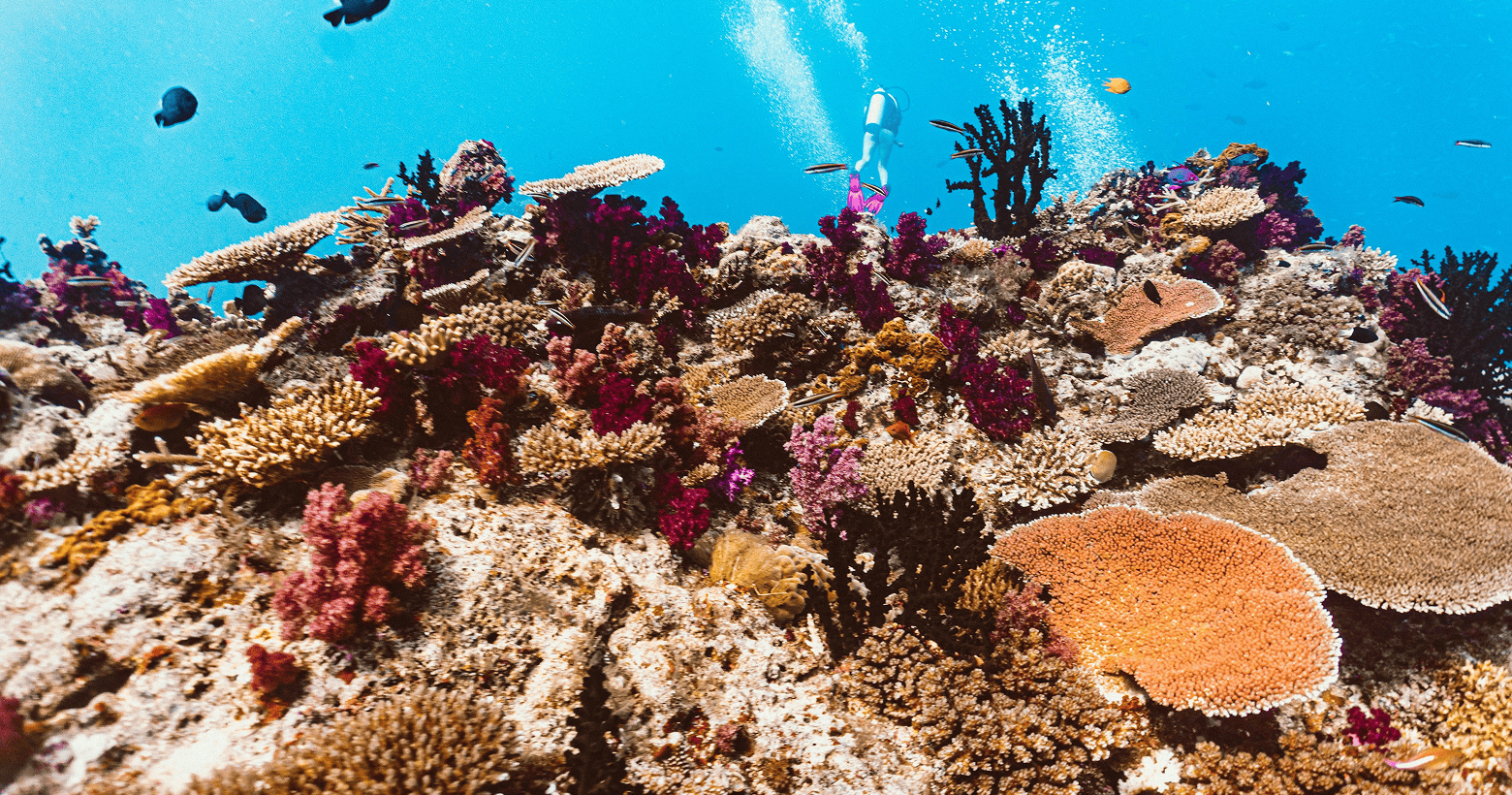

Drop into the water above a Maldivian thila and you’ll see why divers come back to this country year after year. Below you, a coral pinnacle rises from the blue, its sides crusted with hard corals, soft corals, gorgonian fans, and crinoids that catch the current like fingers. Reef sharks patrol the edges. A school of jacks wheels past. Somewhere, almost certainly, an eagle ray glides through.
This is what coral reef scuba diving in the Maldives actually looks like, and it’s why we run Spirit of Maldives the way we do.
If you’re researching scuba diving in coral reefs and weighing destinations, this guide covers what makes Maldivian reefs different, where the best diving lives, what season to choose, and how scuba diving affects coral reefs along with what a thoughtful operation does to keep its footprint small.
What makes the Maldives a coral reef diving destination
The Maldives is a chain of 26 atolls strung along the equator, made up of nearly 1,200 islands surrounded by reef structures that take three main forms: outer reefs that face the open Indian Ocean, channel reefs (locally called kandus) where atoll currents pour in and out, and thilas, which are submerged pinnacles rising from deep water that concentrate marine life like magnets.
For coral reef diving, that variety matters. On a single week-long trip we’ll often visit all three. One morning you’re drifting along a wall in a kandu watching grey reef sharks hold against the current. That afternoon you’re circling a thila looking for frogfish and nudibranchs in the soft coral. Few destinations give you that range without a long surface interval.
The other thing worth saying out loud: Maldivian reefs have been through a lot. Mass bleaching events in 1998 and 2016 hit hard, and recovery has been uneven across the country. But protected sites and remote atolls still hold reefs in genuinely excellent condition, with high coral cover and the predator life that comes with a healthy system. Choosing where you dive matters as much as choosing when.
The best Maldives reef dive sites
A few sites that consistently deliver for coral reef scuba diving:
Fotteyo Kandu (Vaavu Atoll). Often described as one of the top dive sites in the world, Fotteyo is a channel filled with caves, overhangs, and soft coral that explodes with colour when the current’s running. Sharks, tuna, and fusiliers patrol the channel mouth.
Kandooma Thila (South Malé). A teardrop-shaped pinnacle that draws grey reef sharks, eagle rays, and big schools of snapper. The top of the thila sits at around 14 metres and the soft coral on its flanks ruins your photos for any other destination.
Lankan Manta Point (North Malé). A reef cleaning station where mantas come to be groomed by cleaner wrasse. From May through November this site can deliver double-digit manta encounters in a single dive.
Maaya Thila (Ari Atoll). A famous night dive. White-tip reef sharks hunt across the reef while you hover with your torch trained on a soft coral colony, watching the whole food chain switch on.
Hanifaru Bay (Baa Atoll). During the southwest monsoon, plankton funnels into this bay and pulls in mantas and whale sharks in genuinely staggering numbers. Snorkel-only inside the protected zone, but the dive sites surrounding Baa are extraordinary.
This is a small slice. The Maldives has hundreds of named dive sites, and a liveaboard route lets you string the best ones together based on conditions and season.
When to go: choosing your season
Maldivian diving runs year-round, but the experience shifts with the monsoon.
The northeast monsoon (roughly December to April) brings clear water, lighter winds, and the easiest conditions. Visibility on outer reefs often pushes 30 metres. This is the season most divers picture when they think of the Maldives.
The southwest monsoon (May to November) is wetter and the seas are bigger. It’s also when plankton blooms pull in mantas and whale sharks, particularly to Baa Atoll and the western sides of the central atolls. Visibility drops on plankton-rich sites. That’s the trade. You’re swapping clarity for big animals.
Neither season is objectively better. It depends on whether you’re optimising for postcard reef shots or for big-animal encounters.
What you’ll see on a Maldives reef dive
The marine life is the headline here. On a typical week of coral reef diving in the Maldives you can expect grey reef, white-tip, and black-tip reef sharks on most channel and thila dives. Eagle rays often in formation on outer reefs and in channels. Manta rays at cleaning stations and feeding aggregations, seasonal by atoll. Whale sharks year-round in South Ari Atoll and seasonally elsewhere. Big schools of jacks, snapper, fusiliers, and barracuda. Green and hawksbill turtles on most reef dives. And on the thilas, the macro life makes itself known: frogfish, nudibranchs, ghost pipefish, harlequin shrimp.
The reefs themselves are the underlying attraction. A healthy Maldivian reef carries a mix of branching acropora, plate corals, massive porites, and soft coral on the deeper slopes. When the current’s running and the soft coral is open, the colour saturation in the water is hard to overstate.
How does scuba diving affect coral reefs?
This is a question we get a lot, and it’s one worth answering honestly rather than glossing over.
Scuba diving can absolutely damage coral reefs. The mechanisms are well-documented: fin kicks that break branching coral, hands grabbed against reef walls for stability, contact from dangling gear, sediment kicked up by poor buoyancy that smothers polyps, and the cumulative effect of many divers concentrated on a small number of sites. Sunscreen chemicals, particularly oxybenzone and octinoxate, also contribute to coral stress.
That said, scuba diving is far from the largest threat to coral reefs. Climate-driven ocean warming, ocean acidification, agricultural runoff, and destructive fishing practices do orders of magnitude more damage than recreational divers ever will. A well-managed dive operation can actually be a net positive for a reef, because it gives that reef economic value as a living ecosystem rather than as something to be fished out or built over.
Here’s what that looks like on our boats. We brief buoyancy and reef etiquette before every dive. We give newer divers space and time to settle before we drop them onto a delicate thila. We don’t allow gloves at most sites. We use mooring lines rather than anchoring on coral wherever possible. We ask guests to use reef-safe sunscreen and provide information on which brands to bring. We follow the Manta Trust code of conduct around mantas and the local guidelines at Hanifaru. And we limit group sizes, with guides taking small teams underwater rather than crowds.
If you’re newer to diving and worried about your impact, the best thing you can do is the simplest: put time into your buoyancy. A diver who can hover motionless 30 cm above the reef without touching it does almost no harm. Most damage comes from divers who are still figuring out their trim.
Maldives coral reef tours: snorkeling alongside diving
A lot of Maldives coral reef tours combine snorkeling and diving, and there’s a good reason for that. Many of the reefs sit in the top few metres of water, which means non-divers in the group can see most of what divers see: coral gardens, turtles, reef fish, and at the right sites, mantas and whale sharks at the surface.
On our trips, snorkelers are welcome alongside divers. The dhoni (the support boat that runs alongside the liveaboard) makes it easy for snorkelers to hop in and out of sites. Some of the most memorable reef encounters in the Maldives, including whale shark surface feeds and manta cleaning stations in shallow water, happen at depths where snorkeling is genuinely the better tool.
For mixed groups (couples, families, friends with different certifications), this matters. Nobody has to sit on the boat.
Why a liveaboard, for coral reef diving specifically
You can dive the Maldives from a resort, and there are good resorts. But coral reef diving rewards range, and a liveaboard is what gives you that range.
From a fixed resort, you’re diving the reefs within roughly an hour’s boat ride. From a liveaboard, you wake up next to a different atoll every couple of days. We can chase conditions: if the current’s wrong on one site, we move; if mantas are aggregating somewhere unexpected, we go there. Three or four dives a day, no transit time, no packing wet gear into a buggy.
For divers serious about reef variety, that flexibility is the whole point.
Planning your trip
A few practical notes for anyone planning Maldives coral reef diving.
Trips typically run 7 to 10 nights. Itineraries are shaped around season and target species: central atolls and channels in the dry season, Baa and the western atolls during manta and whale shark season. You’ll want at least 25 logged dives before joining most channel-focused itineraries, since some of the famous sites involve real current and aren’t beginner territory. Bring a 3mm wetsuit at minimum, a torch for night dives, and a surface marker buoy.
And take your time. The Maldives isn’t a destination you rush. The reefs reward divers who slow down, watch a single coral head for a few minutes, and notice the second and third layers of life living in it. That’s where the real diving is.
If you’d like to talk through which itinerary fits the diving you’re looking for, get in touch. We’re happy to walk you through the options based on your experience level and what you most want to see underwater.


Leave your comment: