

There are dive destinations, and then there is the Maldives. Spread across 26 atolls in the Indian Ocean, this archipelago offers some of the most spectacular underwater scenery on Earth — and the only way to truly experience it all is from a liveaboard. A liveaboard lets you wake up at remote reefs before day-trippers arrive, follow the marine life across atolls, and pack in three to four dives a day without a long boat ride between them.
This complete guide covers everything you need to know about liveaboard diving in the Maldives — the best dive sites, the marine life you can expect, how to choose the right season and itinerary, what level of experience you need, and how to make the most of every dive.
Why Choose a Liveaboard Over a Resort in the Maldives?
Resort diving is convenient, but it comes with a fundamental limitation: you’re anchored in one place. The Maldives’ finest dive sites — the manta cleaning stations of Baa Atoll, the tiger shark plateaus of Fuvahmulah, the hammerhead schools of Rangali — are rarely within reach of a single resort.
A liveaboard solves this completely. Here is why experienced divers overwhelmingly choose liveaboard trips for the Maldives:
- Access to remote atolls that resort divers never reach
- 3–4 dives per day, including night dives, without long transfers
- The boat moves with the seasons and currents — you go where the marine life is
- Wake up at the dive site — first in the water every morning
- A community of like-minded divers sharing the adventure
Spirit Liveaboards operates the Spirit of Maldives — a purpose-built liveaboard designed to maximize your time underwater while providing genuine comfort above the surface.
Marine Life: What You Will See While Liveaboard Diving in the Maldives
The Maldives sits at a biological crossroads between the Indian Ocean and the Pacific. Nutrients swept in by powerful oceanic currents feed an extraordinary food chain, from microscopic plankton all the way up to the largest fish on the planet.
Manta Rays
Manta rays are the signature encounter of a Maldives liveaboard. Resident reef mantas visit cleaning stations year-round, hovering motionless while tiny wrasse remove parasites. During the southwest monsoon (May–October), Hanifaru Bay in Baa Atoll — a UNESCO Biosphere Reserve — becomes one of the greatest wildlife spectacles on Earth, with hundreds of mantas and whale sharks feeding together in a single lagoon. Only snorkeling is permitted inside Hanifaru, which makes it all the more intimate.
Whale Sharks
The world’s largest fish is a regular fixture on Maldives liveaboard itineraries. South Ari Atoll is one of the most reliably productive whale shark sites on the planet — resident individuals are present throughout the year, not just seasonally. Night-time encounters also occur when whale sharks are attracted to the light emanating from a liveaboard’s hull.
Sharks
The Maldives is one of the few places left on Earth where sharks are truly abundant. White-tip and black-tip reef sharks are seen on almost every dive. Grey reef sharks gather in large numbers in the current-swept channels of Huvadhoo and Addu Atolls. Hammerheads school at depth in specific locations in the south. And Fuvahmulah — a single island atoll rising from the deep ocean floor — is famous for tiger sharks, which can be encountered on dedicated dives at around 30 metres.
Other Pelagic and Reef Species
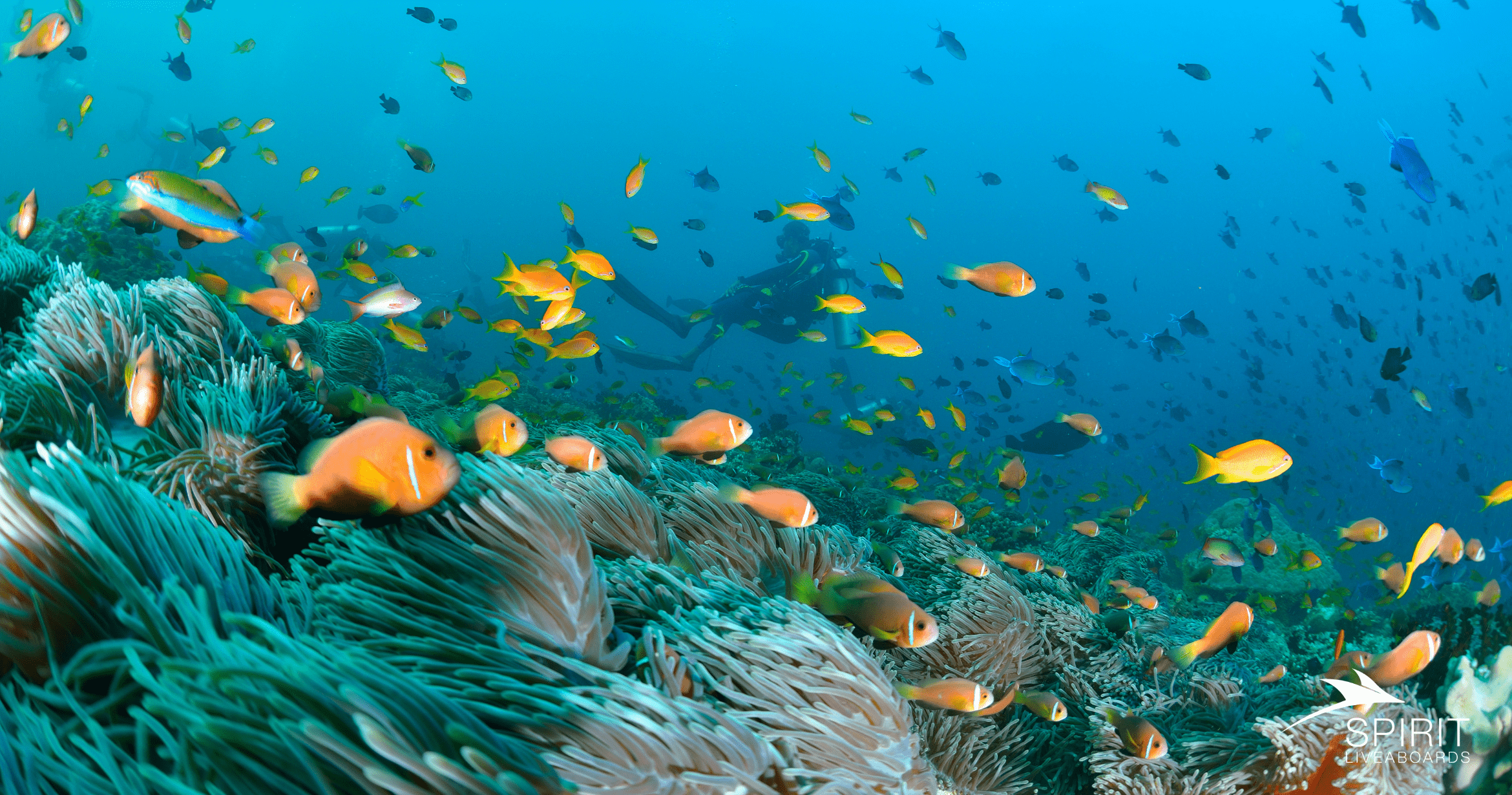
Eagle rays, nurse sharks, sea turtles (hawksbill and green), Napoleon wrasse, schools of barracuda, giant trevally, and vast aggregations of fusiliers and snappers fill every channel dive. The reefs themselves are carpeted in hard and soft corals hosting butterflyfish, angelfish, parrotfish, triggerfish, and countless species of macro life for photographers.
The Best Dive Sites for Liveaboard Diving in the Maldives
The Maldives stretches over 800 kilometres from north to south, and different atolls offer dramatically different diving experiences. Here is what each region offers:
North Malé Atoll and Ari Atoll — The Classic Maldives
The central atolls are where liveaboard diving in the Maldives first built its reputation. North Malé Atoll offers legendary sites like Banana Reef, Maldives Victory Wreck, and Hans Hass Place. Ari Atoll provides consistent whale shark sightings at South Ari Marine Protected Area and world-class manta cleaning stations at Gangehi. These are the atolls of the Spirit of Maldives’ Heart of the Maldives itinerary — a perfect introduction for first-time Maldives divers and a perennial favourite for those returning.
Baa, Raa and Lhaviyani Atolls — The Manta Kingdom
Moving north into the Wonders of the Northern Atolls, the manta action intensifies. The Shark Nursery, Horobadhoo Thila, and the historic Shipwreck Graveyard are highlights, alongside the famous UNESCO Hanifaru lagoon snorkel. Baa Atoll diving is best during the northeast monsoon (November–April) for clear water and peak manta density.
The Far North — Shaviyani and Haa Alifu Atolls
For divers who want to go where very few others have been, the far northern atolls of the Maldives offer untouched reef systems with no crowds and extraordinary shark and manta encounters. These are the oldest atolls in the archipelago, dating back 65 million years. In March and April, the Eight Degree Channel beyond the far north provides opportunities to encounter blue whales and sperm whales in the open ocean — one of the rarest experiences in Maldivian diving.
The Equatorial and Deep South Atolls — Adrenaline Diving
The southern atolls deliver the most powerful channel dives in the Maldives. Huvadhoo Atoll’s deep passages roar with pelagic life — hook into the reef corner and watch schools of jacks, sharks, and rays bank against the current. Fuvahmulah rises sharply from the deep ocean floor, making it a magnet for offshore species including tiger sharks, thresher sharks, and silvertips. Addu Atoll, the southernmost atoll, adds history with the British Loyalty wreck and vibrant manta cleaning stations in the eastern channels.
When to Go: Seasons for Liveaboard Diving in the Maldives
One of the greatest advantages of a liveaboard is the ability to optimise your itinerary for the season. Unlike a resort, the boat can move to wherever conditions are best. Here is how the Maldivian seasons shape the diving:
Northeast Monsoon (November to April) — Peak Season
This is the classic dry season — calmer seas, lower humidity, and outstanding visibility of 20–30+ metres. The northern and central atolls are at their best, and manta sightings are prolific at cleaning stations across Baa, Raa, and Ari Atolls. This is also the season for deep south trips, with the equatorial atolls and the tiger shark sites of Fuvahmulah performing well. Most divers plan their first Maldives liveaboard trip during this window.
Southwest Monsoon (May to October) — The Feeding Season
The southwest monsoon brings nutrient-rich currents that trigger mass feeding events. This is when Hanifaru Bay reaches its peak with hundreds of mantas and whale sharks aggregating in a single lagoon — a sight regarded by marine biologists as one of the greatest spectacles in the ocean. Visibility can be reduced by plankton, but that is precisely what draws the big animals. Experienced divers often specifically choose this season for its extraordinary biomass and energy.
What to Expect on a Maldives Liveaboard: A Typical Day
First-time liveaboard divers often ask what the daily rhythm looks like. Here is a typical day aboard the Spirit of Maldives:
- Early morning: coffee on deck as the boat arrives at the first dive site — already there before sunrise
- Dive 1: the morning dive, often the calmest and clearest
- Breakfast and surface interval: relax on the sun deck, debrief with the dive guide
- Dive 2: a drift dive, channel dive, or a different site nearby
- Lunch: fresh food prepared on board while the vessel repositions
- Dive 3: afternoon dive — often the most dramatic as currents strengthen
- Sunset: on the upper deck, cocktails optional, absolutely unforgettable
- Dinner: the vessel moves overnight to the next atoll
- Night dive: optional — but often when sharks and mantas are most active
Step Aboard the Spirit of Maldives
Before we walk you through a typical day, take a look at where it all happens. This virtual tour of the Spirit of Maldives shows you the cabins, dive deck, sun terraces, jacuzzi, and dining areas — everything that makes life between dives just as enjoyable as the diving itself.
What Experience Do You Need for Liveaboard Diving in the Maldives?
The Maldives is famous for its currents, and this shapes the experience requirements for different itineraries. Here is a practical breakdown:
Heart of the Maldives — Central Atolls
Minimum: Advanced Open Water certification. This itinerary suits intermediate divers who are comfortable with some current and happy diving to 30 metres. The sites are varied, and the dive team manages conditions carefully.
Northern and Far North Atolls
Minimum: Advanced Open Water. Similar conditions to the central atolls, though the far north encounters in the open ocean channel require confidence and composure in blue water.
Deep South and Equatorial Atolls
Minimum: Advanced Open Water plus at least 100 logged dives. The channels in Huvadhoo and the open-ocean plateau at Fuvahmulah involve strong currents, powerful surges, and deeper profiles. Nitrox is strongly recommended. These itineraries are among the most exhilarating in the Maldives, but they demand a calm and experienced diver.
Spirit Liveaboards Itineraries: Finding Your Perfect Maldives Trip
Spirit Liveaboards offers a range of itineraries designed to showcase the full depth of what liveaboard diving in the Maldives can offer:
- Heart of the Maldives (7 or 10+ nights, all year): Central atolls, manta rays, whale sharks, vibrant reefs. Perfect for first-time Maldives divers.
- Wonders of the Northern Atolls (7 or 10+ nights, all year): Baa Atoll manta spectacles, UNESCO Hanifaru snorkel, diverse northern sites.
- Explore the Far North (10+ nights, March–April): Remote reefs, no crowds, blue whale and sperm whale encounters in the open ocean.
- Equatorial Atolls (10+ nights, November–April): Central and southern atolls, manta cleaning stations, dramatic channel dives.
- The Deep South (7 or 10+ nights, November–April): Tiger sharks at Fuvahmulah, historic wreck diving at Addu, powerful adrenaline channels.
All itineraries depart from Malé (Velana International Airport, code: MLE), and some southern routes require a short domestic flight to join the vessel. The Spirit of Maldives cruise director will coordinate all logistics.
Practical Information for Your Maldives Liveaboard Trip
Entry Requirements
All visitors receive a free 30-day tourist visa on arrival. You will need a passport valid for at least six months, confirmed return tickets, and a hotel or liveaboard booking. Travellers must also submit the IMUGA Traveller Declaration online within 96 hours of departure.
Getting There
All international flights arrive at Velana International Airport (MLE) on Hulhule Island near Malé. From there, Spirit Liveaboards will coordinate your transfer to the vessel. For itineraries requiring a domestic flight, connections are via Maldivian Aero — book these well in advance, and allow a minimum two-hour connection at the international terminal.
Water Temperature and Wetsuit
Sea temperatures range from 26°C to 29°C (79–84°F) throughout the year. A 3mm wetsuit is comfortable for most divers; a 5mm suit is recommended for multiple dives per day or for deeper dives in the southern channels.
Nitrox
Nitrox (enriched air) is strongly recommended for liveaboard diving in the Maldives. With 3–4 dives per day, enriched air significantly extends bottom time and reduces fatigue between dives. Nitrox certification is a worthwhile investment if you do not yet have it.
Ready to Plan Your Maldives Liveaboard Diving Trip?
Liveaboard diving in the Maldives is one of the defining experiences in scuba diving. Whether you’re drawn by manta rays at Hanifaru, whale sharks in South Ari, hammerheads in the deep south, or simply the extraordinary privilege of waking up on a remote reef every morning — the Spirit of Maldives is built to deliver all of it.
Spirit Liveaboards offers itineraries year-round, from 7-night introductions to the Heart of the Maldives to 10+ night expeditions to the far north and deep south. The team has dived every site on every itinerary hundreds of times — and they will make sure you see the Maldives at its best.
Check rates and availability at spiritliveaboards.com/book/
FAQs
Is liveaboard diving in the Maldives suitable for beginners?
The Maldives is an intermediate-to-advanced dive destination due to its currents. A minimum of Advanced Open Water certification is required for Spirit Liveaboards itineraries. If you are newly certified, building 20–30 dives in calmer conditions first will make your Maldives experience significantly more rewarding.
How many dives per day can I do on a liveaboard?
Typically 3–4 dives per day, including an optional night dive. A 7-night trip yields approximately 20–24 dives. A 10-night trip can deliver 30 or more.
Is shark diving in the Maldives safe?
Yes. The sharks in the Maldives — reef sharks, whale sharks, even hammerheads — are accustomed to diver presence and pose no meaningful threat when sensible protocol is followed. Spirit Liveaboards' dive guides are experienced in managing shark dives safely and responsibly.
What is the best time of year for liveaboard diving in the Maldives?
November to April is the classic dry season with exceptional visibility and calm seas. May to October brings the feeding season with spectacular manta and whale shark aggregations at Hanifaru Bay. The Maldives is diveable year-round — it simply depends on which experience you prioritise.
Can I extend my trip with a land itinerary?
Yes. Spirit Liveaboards offers pre- and post-cruise extensions in Sri Lanka, combining liveaboard diving in the Maldives with Sri Lanka's world heritage sites, wildlife safaris, whale watching, and cultural experiences.


Leave your comment: