

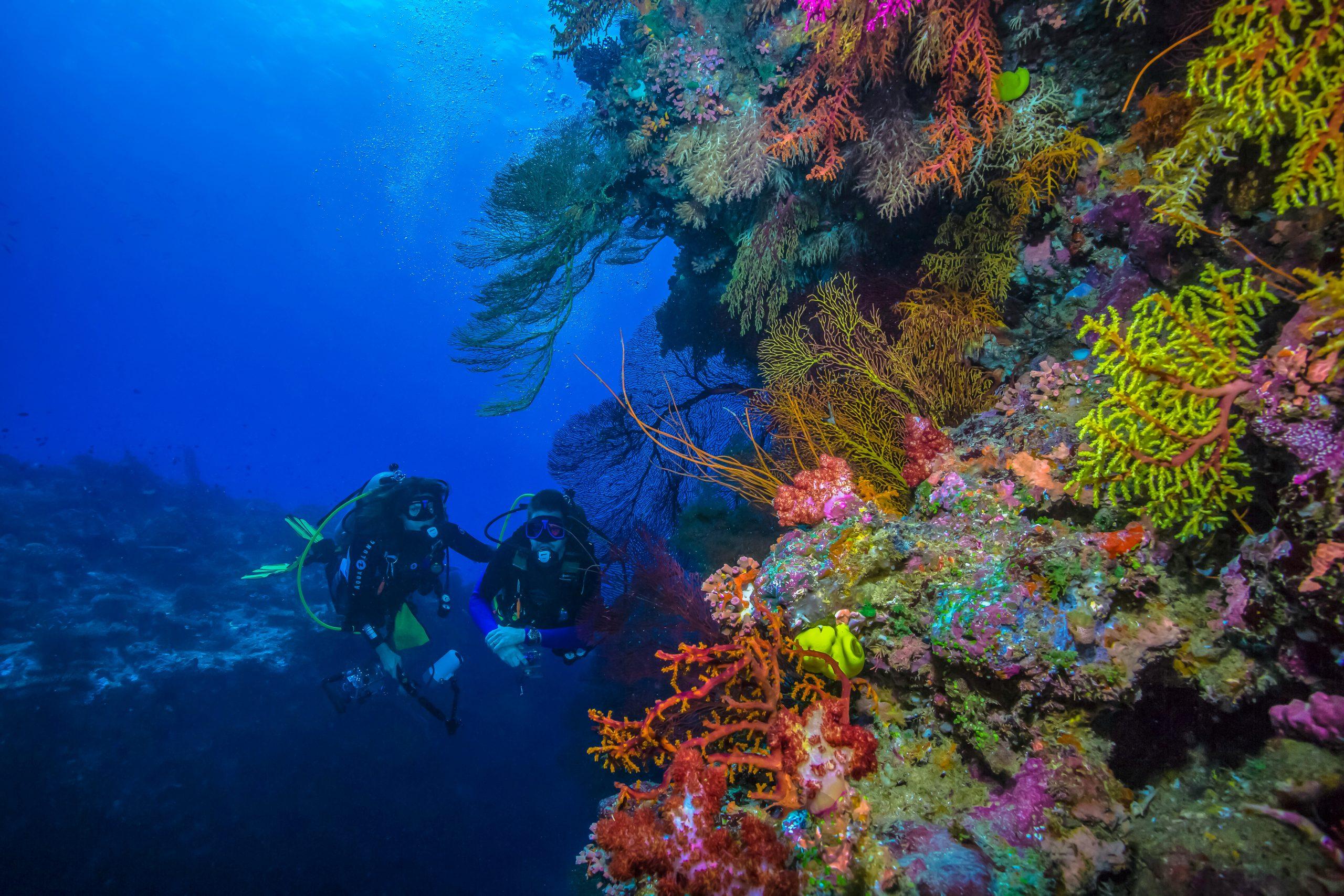

A liveaboard is a dive boat you live on. You sleep in a cabin, eat in the salon, and dive from the back of the vessel three or four times a day for a week or more. The boat moves overnight, so you wake up somewhere new.
That is the whole concept, and it changes diving more than it sounds like it should. Your gear stays assembled on the dive deck for the entire trip. There is no daily boat transfer, no hauling a kit bag down a jetty, no losing an hour each morning to logistics. You go from bed to breakfast to briefing to water in about forty minutes.
The trade-off is that you are on a boat with the same twenty people for a week and there is nowhere else to be. For most divers that turns out to be the best part.
This page covers what a day actually looks like, how many dives you get, what’s included, what to bring, and how to tell whether liveaboard diving suits you. We run the Spirit of Maldives year-round, so the specifics here are our operation rather than a general survey.
What a day on a liveaboard looks like
Roughly this, though the exact times shift with tides and the dive plan.
| Time | What happens |
|---|---|
| 06:15 | Wake-up, light breakfast — fruit, toast, coffee |
| 06:45 | Briefing for dive one on the dive deck |
| 07:00 | Dive one. Usually the deep or high-current dive, when the tide is right |
| 08:15 | Full breakfast |
| 10:30 | Briefing, then dive two |
| 12:30 | Lunch, then a genuine surface interval — sun deck, sleep, camera work |
| 15:00 | Dive three |
| 16:30 | Tea and cake, then either a whale shark snorkel, an island visit, or nothing at all |
| 18:30 | Night dive briefing on nights we run one |
| 19:00 | Night dive |
| 20:00 | Dinner |
| 21:30 | Log books, photo swapping, deck, bed |
The dhoni — a separate support boat that follows the main vessel — carries the tanks and divers to the site. This means the mothership stays put while you dive, and you get picked up wherever the current puts you rather than having to swim back.
Overnight the boat repositions. On our Heart of the Maldives itinerary that might mean going to bed in Vaavu and waking up in South Malé.
How many dives you actually get
A seven-night Maldives trip is typically 25 to 30 dives. Ten nights runs to 35 to 40.
That number surprises people who have only dived from resorts, where two dives a day is a normal maximum once you account for boat schedules. The difference is not that liveaboards cram dives in. It’s that no time is lost getting to the water.
Nobody is required to do all of them. Skipping a dive is normal and nobody comments on it. Most guests skip at least a few over a week, usually the third dive on day four when the accumulated fatigue lands.
Nitrox matters here. Four dives a day for seven days is a lot of nitrogen loading, and Nitrox gives you meaningfully more bottom time and shorter surface intervals. We recommend it strongly and most guests use it.
Liveaboard vs resort diving
The honest comparison, including where a resort wins.
| Resort | Liveaboard | |
|---|---|---|
| Dives per day | 2, occasionally 3 | 3–4, plus night dives |
| Sites reachable | 8–15 within boat range | 40+ across multiple atolls |
| Gear handling | Set up and break down daily | Set up once, stays on your station all week |
| Timing flexibility | Fixed departure schedule | Boat sits on the corner when the tide turns, even if that’s 6am |
| Non-divers | Excellent — beach, spa, pool, restaurants | Good but limited — snorkelling, kayaking, island visits, deck |
| Privacy | Your own room, your own space | Cabin plus shared common areas, always |
| Cost structure | Room rate plus per-dive fees, meals, transfers | One rate covering dives, meals, cabin, transfers |
| Land options | Full resort facilities | You are on a boat |
| Best for | Mixed diving-and-holiday trips, families, non-diving partners | Divers whose priority is diving |
A resort is a better holiday. A aboveboard is better diving. If you are travelling with someone who does not dive and does not much want to be on a boat, be honest about that before booking.
The cost picture is less obvious than it looks. A seven-night liveaboard rate covers 25 to 30 dives, all meals, your cabin and transfers in a single number. At a resort, the room rate is only the start — daily boat fees, per-dive charges, equipment rental and meals stack on top. Per dive, liveaboards usually come out cheaper. Current rates and departures are on our booking page, and live deals sit under special offers.
Who liveaboard diving suits
It suits you if: you want to dive more than you want to sunbathe, you’re comfortable in current, you don’t mind close quarters, and you’d rather eat with the same twenty people every night than have restaurant options.
Think harder if: you get badly seasick and haven’t found a medication that works, you need reliable Wi-Fi for work, you’re travelling with young children, or your partner has no interest in the water. None of these are absolute barriers. They’re just worth resolving before you book rather than on day two.
Certification: our Maldives itineraries require Advanced Open Water as a minimum, and the Deep South and Equatorial routes also require 100 logged dives. That’s about current, not gatekeeping — the channel dives assume you can do a negative entry, descend fast and hook in. Our drift diving guide covers the skills involved.
Newer divers are not shut out. There is enough diving in the calmer atolls to fill a week, and the guides route to your comfort level rather than through it. Tell them honestly what you’ve done.
What’s included, and what isn’t
Included on our trips:
- Cabin with en-suite and air conditioning
- All meals, snacks, tea, coffee, drinking water
- Three to four guided dives a day, tanks and weights
- Dhoni transfers to every dive site
- Airport transfers on embarkation and disembarkation days
- Guides, briefings, conservation presentations
- Fuel surcharge, green tax, port fees, marine park fees, government tax
Not included:
- International and domestic flights
- Nitrox (a per-trip supplement, and worth it)
- Full equipment rental if you don’t bring your own
- Alcohol and soft drinks
- Hanifaru Bay conservation permits, where the excursion applies
- Crew gratuities
- Dive and travel insurance, both of which are mandatory
Ask about anything not on either list rather than assuming. Operators differ a lot on what “all-inclusive” means, and the marine park and government fees are where the surprises usually hide.
Packing: what to actually bring
Cabin storage is limited. Soft bags are better than hard cases because they compress and stow.
Dive kit
- Mask you know fits. The one item worth carrying no matter what else you rent.
- Dive computer, plus the manual if it’s new to you. Nitrox-capable if you plan to use Nitrox.
- 3mm wetsuit for the Maldives (water sits at 27–30°C year-round). A shorty works for some people; a full 3mm is more comfortable over four dives a day. Fiji runs slightly cooler — 3mm to 5mm depending on the month.
- Reef hook and 1.5 m line. Essential for channel diving and often forgotten.
- SMB and reel or spool. Non-negotiable in drift conditions.
- Fins, boots, regulator, BCD if you’re bringing your own.
- Spares: mask strap, fin strap, O-rings, computer battery, mouthpiece and a couple of cable ties. Small, weightless, and they save dives.
Above water
- High-SPF reef-safe sunscreen. Bring more than you think.
- Wide-brimmed hat, sunglasses with a retainer strap
- Long-sleeved light shirt — more useful than sunscreen after three days
- Two or three sets of shorts and t-shirts, swimwear ×2 so one is always dry
- Light fleece or hoodie for night dives and wind on deck
- Reef-safe shoes for island visits
- Seasickness medication, started before departure rather than after symptoms
- Personal medications, in original packaging, plus a basic kit: antihistamine, painkillers, blister plasters, decongestant
- Reusable water bottle
- Dry bag for the dhoni
Photo and electronics
- Camera, housing, and every O-ring and spare battery you own
- Memory cards — more than you’ll need
- Universal adapter (the Maldives uses UK three-pin, 220V)
- Charger multiplug, since cabin sockets are few
- Downloaded books, films and music. Assume no usable internet.
Our full pre-trip document is Know Before You Go, which covers visas, luggage allowances on domestic flights, and transfer timings.
Rent or bring your own?
Bring: mask, computer, reef hook, SMB, and your wetsuit if you have one that fits. These are the items where fit and familiarity matter and rental compromise costs you comfort.
Rent without much worry: BCD, regulator, fins, boots. Well-maintained rental kit is genuinely fine, and a full set saves 15 kg of baggage and the airline fees that come with it. Our full set is a per-trip charge covering mask, fins, wetsuit, regulator, BCD and computer.
The middle case is regulators. Divers who own a regulator they trust usually want it. If yours is due a service, get it done well before departure — a regulator that starts free-flowing on day one of a remote itinerary is a week-long problem, not a day-long one.
Seasickness, honestly
Some people get seasick on liveaboards. Most of those people get over it in 24 to 36 hours.
What works:
- Start medication the night before boarding, not when you feel unwell. Most of it is preventive and near-useless once nausea has begun.
- Stay on deck with a view of the horizon. Cabins and reading below deck make it worse.
- Eat something plain. An empty stomach is worse than a full one.
- Get in the water. Diving almost always stops it.
- Midship lower cabins move least. Ask about cabin position if you know you’re susceptible.
Overnight crossings are when it bites, which is why the boat does most of its moving while you sleep.
Non-divers on board
Non-diving guests are welcome on every one of our itineraries at a 10% discount on the cabin rate. Mention “snorkeling guest” in the booking comments.
What they do while you’re underwater: snorkel the same sites from the dhoni or the boat, which for whale sharks and mantas is often the better vantage point anyway. Guided kayaking around the atolls. Island and local village visits. Sunset on the top deck.
Two things to be straight about. A liveaboard is a small space and the schedule revolves around diving, so a non-diver who has no interest in the ocean will find a week long. But someone who likes snorkelling will do very well — see snorkeling in the Maldives, and the whale shark encounters in South Ari are snorkel-based for everyone, divers included (full guide here).
Courses are possible on board for guests wanting to certify or add a specialty. Arrange it before you travel, not on day one — it affects the dive planning for the week.
Photographers on a liveaboard
Liveaboards are the best platform for underwater photography there is, mostly for boring logistical reasons. Your camera lives on a dedicated rinse-and-charge station. You dive the same site twice on consecutive days when the first attempt didn’t work. You get night dives.
Practical notes:
- Get close, then closer. Water between lens and subject kills everything.
- Shoot upward. Blue water behind the subject beats reef clutter.
- Wide-angle for reefscapes, channel walls and big animals; macro for the thilas. Bringing both means committing per dive, so read the briefing.
- Strobes below about 15 m, natural light above it.
- No flash on whale sharks or mantas. It’s banned in Hanifaru and it’s bad practice everywhere.
- Set white balance manually if you shoot video.
- Don’t back up while shooting. It’s the main way people wreck other divers’ encounters and contact the reef.
Tell us when you book that you’re shooting seriously. It affects where we put you on the deck and how the guide positions the group.
Onboard etiquette
Unwritten but universal:
- Be geared up and ready at the briefed time. A boat of twenty runs on the slowest person.
- Your station is yours. Nobody else’s kit goes on it and yours doesn’t spread onto theirs.
- Rinse tanks are for cameras or for masks, not both. Check which is which.
- Fresh water is finite. Short showers.
- Quiet after about 22:00. Someone is diving at 6am.
- Log your dive with the guide and report anything that went wrong, including your own mistakes. It changes the plan for tomorrow.
- Tip as a group at the end, through the cruise director.
Where and when: the Maldives
Diving is good year-round, which is not marketing — it’s why the boat runs twelve months a year. The two monsoons produce different diving rather than good and bad diving.
Northeast monsoon, December to April. Dry, calm, visibility often 25–30 m and beyond. The eastern channels run clear. Peak season, and the easiest conditions for a first liveaboard.
Southwest monsoon, May to November. More plankton in the water, so visibility drops. That plankton is also the reason mantas aggregate at Hanifaru Bay in Baa Atoll between roughly June and November, and why whale shark density stays high. Fewer boats, better prices.
The month-by-month detail, including which itinerary suits which period, is in our best time to dive the Maldives guide. For the dive sites themselves, see our breakdown of the central atolls and the coral reef guide.
A note on Hanifaru: it’s snorkel-only by law, ranger-managed, with capped 45-minute sessions and a conservation permit. Liveaboards can’t enter the bay directly — guests transfer in from Dharavandhoo by permitted boat. Any itinerary promising you a Hanifaru dive is promising something illegal.
Planning a first trip
The two questions that decide everything: how many dives have you logged, and what do you want to see. Answer those and the itinerary picks itself.
Get in touch with your dates, certification level and dive count and we’ll tell you which departure fits — including if the answer is that you’d be better off waiting a season and getting more current experience first.
FAQs
What is liveaboard diving?
Diving from a boat you live on for the duration of the trip. You sleep, eat and dive from the same vessel, which repositions overnight to reach sites day boats can't.
How many dives per day on a liveaboard?
Three to four, plus night dives on some evenings. A seven-night Maldives trip is typically 25 to 30 dives.
Do I need to be an experienced diver?
Our Maldives itineraries require Advanced Open Water; the southern routes also require 100 logged dives. Newer divers can be accommodated on the calmer atolls but the channel sites need current experience.
Is liveaboard diving expensive?
The headline rate is higher than a hotel room, but it covers dives, meals, cabin and transfers. Per dive it usually works out cheaper than a resort once you add daily boat fees, per-dive charges and meals.
Will I get seasick?
Possibly, for the first day. Start medication before boarding, stay on deck, and get in the water. Most people are fine by day two.
Can non-divers come?
Yes, on all our itineraries, at a 10% discount on the cabin rate. Snorkelling, kayaking and island visits fill the day.
Should I bring my own gear or rent?
Bring mask, computer, reef hook and SMB. Renting BCD, regulator and fins is fine and saves significant baggage weight.
Is there Wi-Fi on a liveaboard?
Limited and unreliable. Plan for no usable internet and download what you need before boarding.
What should I pack for a liveaboard trip?
Soft bag, mask, computer, 3mm wetsuit, reef hook, SMB, spares kit, high-SPF sunscreen, hat, light long-sleeved shirt, seasickness medication, universal adapter, and more memory cards than you think you need.
Do I need dive insurance?
Yes. Dive and travel insurance are both mandatory on our trips, and you'll be asked for the policy details.
How far in advance should I book?
Six to twelve months for peak season, particularly if you need specific cabin types or domestic flight connections. Domestic flights in the Maldives need booking well ahead.


Leave your comment: